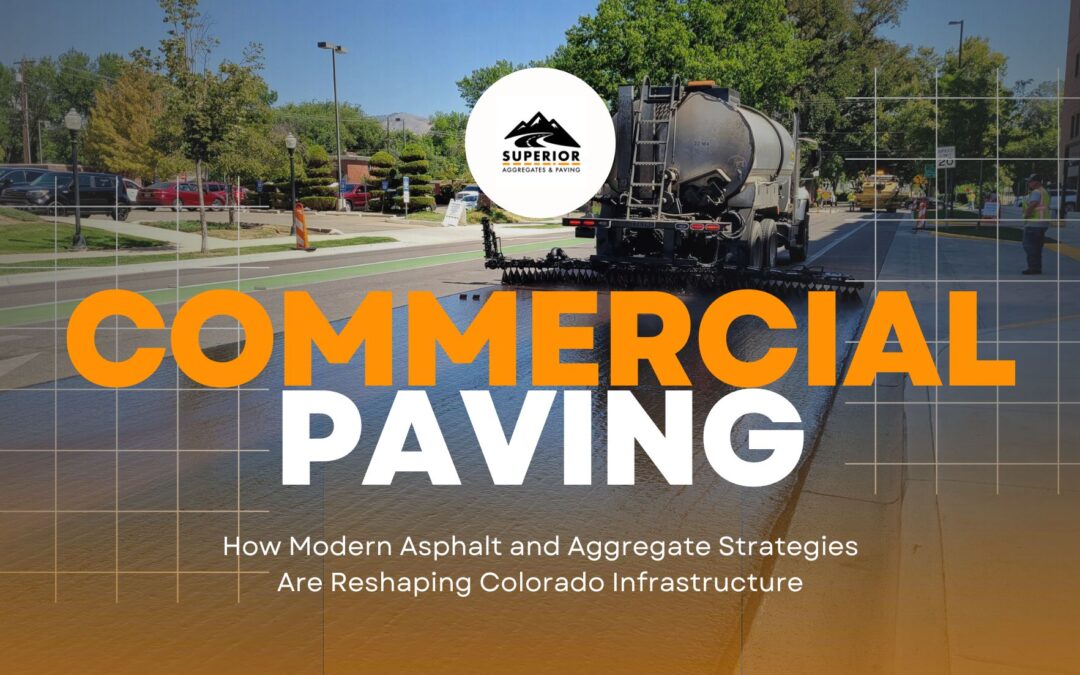
In 2026, commercial paving is no longer just about placing asphalt or concrete it’s about engineering long-term performance. Across Colorado’s Front Range, from Denver and Boulder to Broomfield, Brighton, Erie, Longmont, and surrounding communities, property owners and municipalities are demanding pavements that last longer, perform better under extreme weather, and deliver measurable lifecycle value.
This shift is driven by heavier traffic loads, changing climate conditions, tighter regulations, and rising replacement costs. As a result, modern paving projects now focus on advanced materials, intelligent construction methods, engineered aggregates, and data-driven maintenance planning. This article explores how commercial asphalt and aggregate strategies have evolved in 2026 and what that means for developers, municipalities, and facility managers throughout Northern Colorado.
Pavement Design Has Become a Performance Strategy
Commercial pavement is no longer viewed as a short-term surface solution. In 2026, it is treated as a long-term infrastructure asset, particularly in high-growth markets like Denver, Broomfield, and Erie, where industrial parks, distribution centers, and mixed-use developments are expanding rapidly.
Instead of asking, “How thick should the asphalt be?”, today’s projects ask:
- How will this pavement perform under sustained truck traffic?
- How will freeze-thaw cycles affect it over 15–25 years?
- What maintenance strategy will extend its usable life?
Performance-based pavement design evaluates traffic loading, drainage conditions, subgrade strength, and climate exposure, ensuring that commercial asphalt and concrete installations are built to handle real-world demands not just minimum specifications.
High-Performance Asphalt Mixes Dominate Commercial Projects
Standard hot-mix asphalt is increasingly replaced by engineered asphalt blends designed for Colorado’s unique conditions, including rapid temperature swings, intense UV exposure, and snow-management equipment.
Key asphalt advancements in 2026 include:
Polymer-Modified Asphalt Binders
These binders improve flexibility and rut resistance, making them ideal for:
- Warehouse loading zones in Brighton and Commerce City
- High-traffic retail centers in Broomfield
- Industrial yards across the Denver metro area
Polymer modification helps pavements resist cracking in winter and deformation during summer heat.
Balanced Mix Design (BMD)
Balanced mix design evaluates cracking resistance, rutting performance, and moisture durability simultaneously. This approach ensures asphalt performs as intended across its entire service life, especially in municipalities like Boulder and Longmont, where sustainability and longevity are high priorities.
Advanced Recycled Asphalt Integration
Reclaimed Asphalt Pavement (RAP) is now incorporated using tighter quality controls and rejuvenators. This allows higher RAP content while maintaining performance, reducing material costs and supporting sustainability goals across Colorado commercial developments.
Aggregates Are Now Engineered for Structural Performance
Aggregates are no longer treated as generic materials. In 2026, aggregate selection is a critical engineering decision especially for base layers that determine pavement lifespan.
Across projects in Erie, Brighton, and Denver, high-quality aggregates are evaluated for:
- Angularity and fracture count for load interlock
- Durability under repeated freeze-thaw cycles
- Compatibility with modern asphalt binders
- Drainage characteristics to prevent water-related failures
Engineered aggregate bases reduce settlement, improve load distribution, and minimize long-term cracking. This is particularly important for large commercial sites and municipal roadways throughout Northern Colorado.
Intelligent Compaction Is Now a Commercial Standard
Proper compaction remains one of the most important factors in asphalt performance. In 2026, intelligent compaction (IC) is widely expected on commercial paving projects.
IC technology uses GPS-enabled rollers to measure:
- Material stiffness
- Pass coverage
- Compaction uniformity
Instead of relying on isolated density tests, contractors now provide full-surface compaction maps. This approach ensures consistent density across parking lots, roadways, and access drives in places like Broomfield, Erie, and Boulder, significantly reducing premature pavement failure.
For commercial property owners, intelligent compaction offers transparency, accountability, and confidence that the pavement was built correctly from day one.
Climate-Resilient Pavement Design Is Essential in Colorado
Colorado’s climate presents unique challenges: heavy snowfall, freeze-thaw cycles, intense sun exposure, and sudden temperature swings. In 2026, climate resilience is no longer optional it’s central to pavement design.
Modern climate-adaptive strategies include:
Improved Drainage Systems
Water remains the number-one enemy of pavement. Engineered base layers and subsurface drainage systems help prevent saturation, reducing cracking and structural breakdown in cities like Longmont and Brighton.
Permeable and Semi-Permeable Asphalt
Used in select parking areas and commercial campuses, permeable asphalt reduces runoff and supports stormwater management goals, especially in environmentally conscious communities like Boulder and Erie.
Thermal Stress Mitigation
Advanced mix designs and joint strategies accommodate expansion and contraction, reducing cracking caused by extreme temperature swings common along the Front Range.
Digital Construction and Site Control Improve Outcomes
Commercial paving in 2026 relies heavily on digital construction tools to improve accuracy, speed, and consistency.
Key advancements include:
- GPS-guided grading and paving equipment
- Automated screed controls for uniform asphalt thickness
- Real-time temperature monitoring during placement
- Integrated logistics between asphalt plants and paving crews
These technologies allow projects in Denver, Broomfield, and surrounding areas to be completed faster while maintaining strict quality standards minimizing downtime for businesses and municipalities.
Sustainability Is Measured by Results, Not Claims
Sustainability in 2026 is no longer marketing-driven. It’s evaluated through measurable performance outcomes, particularly on public-sector and large commercial projects.
Modern sustainable paving practices include:
- Warm-mix asphalt to reduce fuel consumption and emissions
- Higher recycled content without sacrificing durability
- Reduced material waste through precise mix control
- Longer pavement life cycles that limit full-depth replacement
Across Colorado, municipalities and developers increasingly prioritize paving partners who deliver both environmental responsibility and structural performance.
Maintenance Is Predictive, Not Reactive
Perhaps the most significant evolution in 2026 is how pavements are maintained.
Instead of waiting for visible cracking or failure, commercial property owners now rely on:
- Condition assessments
- Performance modeling
- Usage and traffic data
This predictive approach allows owners in Denver, Boulder, Erie, and Broomfield to:
- Perform maintenance at the optimal time
- Extend pavement life by years
- Avoid costly emergency repairs
Preventive maintenance is now viewed as a strategic investment rather than an expense.
What This Means for Commercial Property Owners Across Northern Colorado
For developers, facility managers, and municipalities, the takeaway is clear: lowest initial cost no longer delivers the best value.
In 2026, successful commercial paving projects are defined by:
- Performance-based design
- Engineered aggregates and asphalt mixes
- Intelligent construction verification
- Climate-resilient strategies
- Long-term maintenance planning
Choosing an experienced paving contractor who understands these principles is essential for protecting infrastructure investments across Denver, Boulder, Brighton, Broomfield, Erie, and the greater Front Range.
Why Location-Specific Expertise Matters in Commercial Paving
While modern materials and technology define commercial paving in 2026, local expertise remains a critical success factor. Pavement performance in Denver, Boulder, Brighton, Broomfield, Erie, and Longmont is heavily influenced by regional soil conditions, elevation changes, and traffic patterns that generic designs often fail to address.
For example, expansive soils common in parts of Broomfield and Erie require specialized base preparation to prevent movement and cracking. High-altitude UV exposure in Boulder and Longmont accelerates binder aging, demanding asphalt mixes with enhanced oxidation resistance. Meanwhile, dense commercial corridors in Denver and Brighton experience sustained heavy truck traffic that requires thicker structural sections and higher-performance aggregates.
Contractors with true Front Range experience understand how these variables interact—and how to design pavements that hold up over time rather than simply meeting minimum code. This localized approach results in:
- Reduced premature cracking and rutting
- Improved drainage and freeze-thaw resistance
- More predictable maintenance cycles
- Lower long-term ownership costs
In 2026, commercial property owners increasingly prioritize paving partners who combine regional knowledge with modern engineering practices. The ability to adapt pavement design and construction methods to specific Colorado locations is no longer a bonus—it’s a requirement for long-lasting infrastructure.
The Future of Commercial Paving Is Already Here
Commercial paving in 2026 is smarter, stronger, and more strategic than ever before. It blends engineering, technology, sustainability, and data to deliver pavements that last longer and perform better under real-world conditions.
For growing Colorado communities and commercial developments, modern asphalt and aggregate strategies are no longer optional they are the foundation of resilient infrastructure.
Superior Aggregates & Paving operates within this modern framework every day, delivering commercial paving solutions designed for performance, durability, and long-term value across Northern Colorado.